LOW – HIGH GAIN Overdrive / Distortion / BOOST

  • Approved by Steve Lukather
  • Official Steve Lukather Overdrive Pedal
  • Sound Design by Steve Lukather and Uli Rodenberg
  • Tested, played, and approved by Steve Lukather
  • Official branding on the pedal
  • SL-OD DELUXE – The Modern One
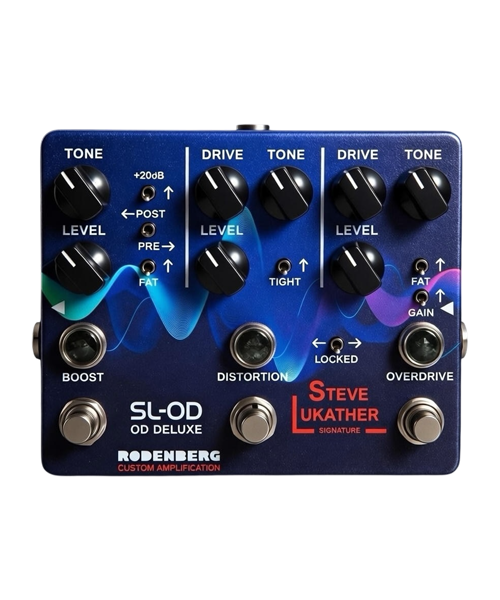
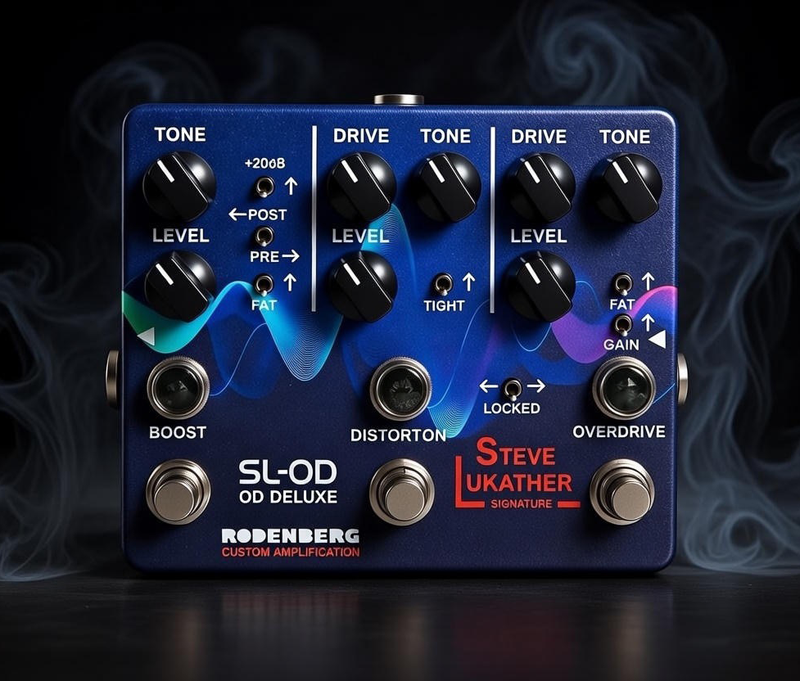
    The SL-OD DELUXE combines three completely independent effect units in one single enclosure, delivering uncompromising audio quality, stage ready practically, and signature sound. Developed in direct collaboration with Steve Lukather, for musicians who demand maximal control, tonal versatility, and flexibility at the highest level.

FEATURES

  • The SL-OD DELUXE combines three completely independent sounds: LOW – HIGH GAIN Overdrive, Distortion, and BOOST Sound in one pedal.
  • The LOCKED switch connects the Overdrive and Distortion sounds in a locked mode, allowing seamless switching between both sounds with a single foot press.
  • PRE / POST toggle switch for changing the signal chain of the BOOST channel.
  • Each channel delivers its own sound characteristics, switchable presets, and precise control via Level, Tone, and Drive (LOW GAIN – HIGH GAIN OD, DISTORTION), and via Level and Tone (BOOST).
  • GAIN and FAT BOOST preset switches in the Overdrive sound. TIGHT mode preset switch in the Distortion sound. FAT mode and +20dB preset switch in the BOOST sound.
  • The pedal operates with a special, mechanical True Bypass circuit that switches almost silently thanks to optimized interference suppression technology, ideal for professional stage conditions.
  • Handcrafted in Germany, the SL-OD delivers maximum dynamics, tonal fidelity, and flexibility for musicians who demand uncompromising performance.

CLEAN / DRIVE

In front of a clean amp

If you play the pedal in front of a clean or slightly overdriven amp, you get an open overdrive and medium distortion sound. The tone remains clear, structured, and assertive.

If you want to get even more gain out of a clean amp, you can simply stack the pedals, i.e., connect them in series. This gives you a massive portion of extra gain in the setup. Important: The level controls of the individual pedals should be cleanly matched to each other so that the sound remains open, dynamic, and controllable.

Some players claim the pedal only works well in front of an already distorted amp. In reality, this is not a limitation of the pedal itself, but rather a matter of application, settings, and amp configuration.

In front of an overdriven, distorted amp

When used in front of an already overdriven amp, the pedal reveals its second major strength, exactly the way Steve Lukather uses it. The sound becomes tighter, more focused, and more lead-oriented, with additional gain, while preserving the core character of the amp. Rather than altering the amp’s tone, the pedal integrates organically, pushing the amp further into its sweet spot.

Steve Lukather:
,I hear you EVERY night, it’s my fave Overdrive / Distortion pedal! I use them (SL-OD, SL-OD Deluxe / SL-OD DLX) in various situations, in the studio, live etc.‘

Steve Lukather has been using my pedals continuously since 2017, live and in the studio. For him, it’s his ‚Main Overdrive‘.
Reliable, full of character, and an integral part of his sound.

SOUNDS
LOW - HIGH GAIN Overdrive
  • Jewel LED Blue
  • FAT Boost (Preset Toggle Switch)
  • GAIN BOOST (Preset Toggle Switch)
  • Controls: Level, Tone, Drive
DISTORTION
  • Jewel LED Red
  • Tight Mode (Preset Toggle Switch)
  • Controls: Level, Tone, Drive
BOOST
  • Jewel LED Green
  • FAT Boost (Preset Toggle Switch)
  • +20 dB Level Boost (Preset Toggle Switch)
  • Dynamic Level Boost
  • Almost like an exciter
  • Controls: Level, Tone
SPECS
LOCKED Mode
  • Locking of the OVERDRIVE and DISTORTION Sound
  • Switch back and forth between the OVERDRIVE and DISTORTION pedal with just one foot press. Ideal for fixed routing or live setups
PRE / POST Toggle Switch for the BOOST
  • Signal chain of the BOOST Channel can be switched flexibly
  • POST: Guitar → Overdrive → Distortion → Boost → Amp
  • PRE: Guitar → Boost → Overdrive → Distortion → Amp
Silent True Bypass
  • True Bypass footswitch, mechanical
  • Newly developed circuit design
  • Nearly no switching noise
Power supply
  • 9-18V DC, 60–100 mA
  • Standard supply voltage 9V DC
  • Max. supply voltage 18V DC
  • No battery operation
Dimensions
  • Aluminum enclosure, black, powder-coated
  • Dimensions: 5.7 in x 4.8 in x 1,5 in (w/d/h)
  • Weight 1.1 lbs
Made in Germany
  • 3 year warranty
  • Handcrafted in small batches

VIDEOS

SL-OD DELUXE demo by Fabian Ratsak
SL-OD DELUXE demo by Guido Bungenstock
SL-OD DELUXE talk by Jon Gosnell
SL-OD DELUXE demo by Fabian Ratsak

FAQ

Background noise:
LEVEL CONTROLS – Three completely independent pedals in one enclosure
Each sound of the SL-OD DELUXE operates completely independently. To ensure perfect interaction between the sounds, the Level controls should be carefully adjusted. Setting all three channels to maximum can result in extremely high output levels and may cause the pedal to behave uncontrollably. With precisely matched level settings for each channel, the sound remains open, dynamic, and fully controllable.

Power supply 9V DC – 18V DC
The pedal can be operated with 9–18V DC.
Regardless of the supplied voltage, the internal circuitry is fully stabilized, ensuring that the core tone remains unchanged. The standard operating voltage is 9V DC, this is also how Steve Lukather uses the pedal.
Higher voltage operation is possible, but not required..

Power Supply Note:
For noise-free operation, we recommend using a well-regulated, properly shielded power supply.
Some digital power supplies, especially those with insufficient shielding, may introduce hum or high-pitched noise.

When using a multi-output power supply, the outputs should be galvanically isolated from each other.

If noise occurs, it is not generated by the pedal itself, but rather caused by an unsuitable power supply or an unfavorable combination of devices. It is possible that a power supply works perfectly with one pedal, but causes noise issues when used with another.

We recommend the following test if noise occurs: Connect the pedal directly in front of the amplifier, without connecting a guitar, and power it using a separate power supply. When switching the pedal on, only normal switching or gain-related control noises should be audible. There should be no hum and no high-pitched noise.
This test is very effective for checking the pedal independently of the rest of the signal chain.