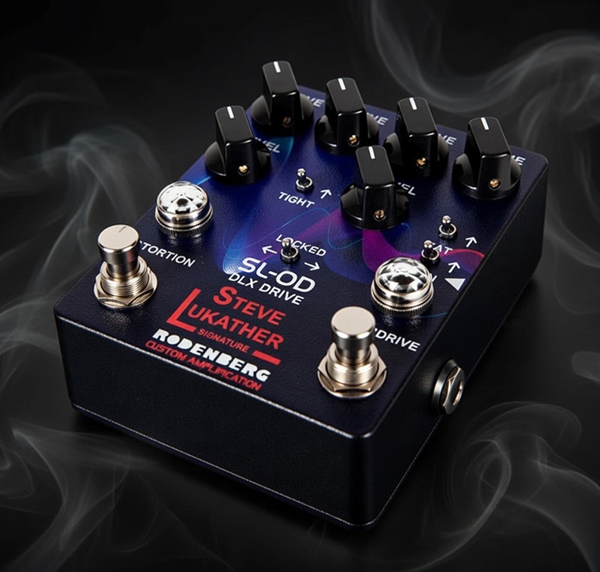
LOW – HIGH GAIN Overdrive / Distortion
When you run the pedal into a clean or slightly breaking-up amp, you get an open overdrive sound that can reach into high-gain territory without drifting into extreme distortion. The tone remains clear, structured, and highly articulate, with excellent note definition and cut.
If you want even more gain from a clean amp, you can simply stack pedals by running them in series. This gives you a substantial increase in overall gain. Important: The level controls of the individual pedals should be carefully balanced to keep the sound open, dynamic, and fully controllable.
Some users claim that the pedal only works well in front of a distorted amp, but this is not a limitation of the pedal itself. It comes down to how it is used, how it is set up, and the amp configuration.
In front of an already driven amp, the pedal reveals its second major strength, exactly the way Steve Lukather uses it. The sound becomes faster, more focused, and more lead-oriented, adding gain without drastically altering the existing amp tone. The pedal integrates organically into the already working amp, enhancing what is there rather than replacing it.
Steve Lukather:
,I hear you EVERY night, it’s my fave Overdrive / Distortion pedal! I use them (SL-OD, SL-OD Deluxe / SL-OD DLX DRIVE) in various situations, in the studio, live etc.‘
Steve Lukather has been using my pedals continuously since 2017, both live and in the studio. For him, it is his main overdrive: reliable, full of character, and a permanent part of his sound.
Noise / Side Noise:
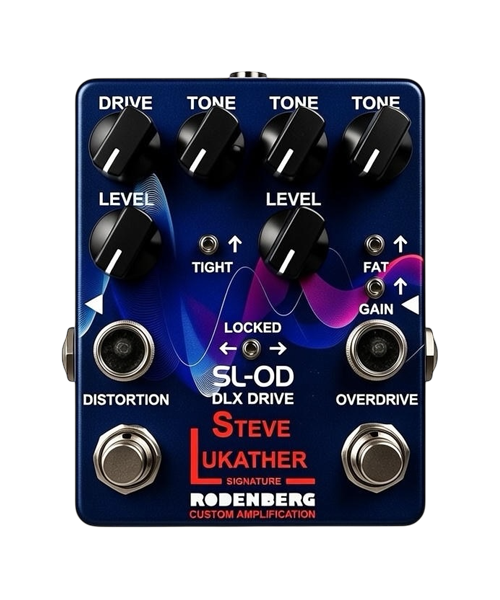
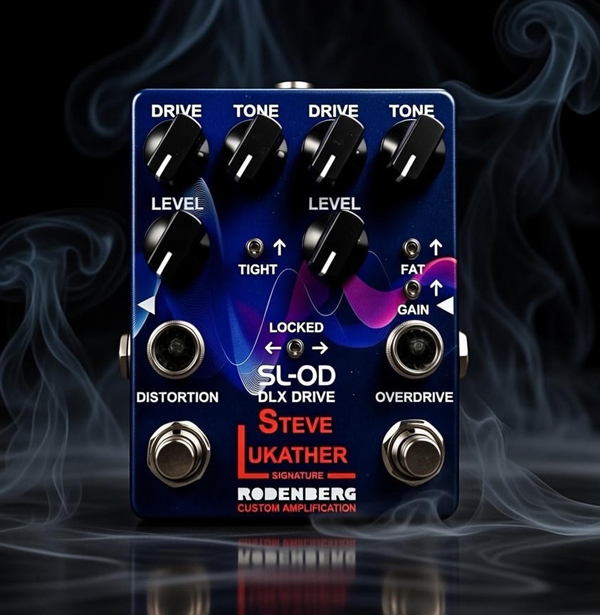
Level controls: Two completely independent pedals in one enclosure!
Each sound of the SL-OD DLX DRIVE operates fully independently. To keep the interaction perfectly balanced, the level controls should be carefully adjusted. Running all two channels at maximum settings produces extremely high output levels and may cause the pedal to become difficult to control. With finely balanced level settings for each channel, the sound remains precise, dynamic, and fully controlled.
Power Supply: 9V DC – 18V DC:
The pedal can be operated with 9–18V DC. Regardless of the supplied voltage, the internal circuitry remains fully stabilized, ensuring that the fundamental tone does not change.
The standard operating voltage is 9V DC, this is also how Steve Lukather runs the pedal.
A higher voltage is possible, but not necessary.
Higher voltage operation is possible, but not required.
Power Supply Notice:
For noise-free operation, we recommend using a stabilized, well-shielded power supply. Some digital power supplies, especially those with insufficient shielding, may cause hum or high-pitched noise.
When using a multi-output power supply, the outputs should be galvanically isolated from each other.
Any noise issues do not originate from the pedal itself, but are usually caused by an unsuitable power supply or an unfavorable device combination. It is possible that a power supply works perfectly with one pedal but produces noise with another.
If noise occurs, we recommend the following test:
Das Pedal allein vor den Verstärker schalten, keine Gitarre anschließen und das Pedal separat mit einem Netzteil versorgen. Beim Einschalten dürfen lediglich die bedienungs- bzw. gainabhängigen Schalt- und Regelgeräusche auftreten, kein Brummen und kein Pfeifen. Dieser Test eignet sich sehr gut, um ein Pedal unabhängig vom restlichen Setup zu überprüfen.