

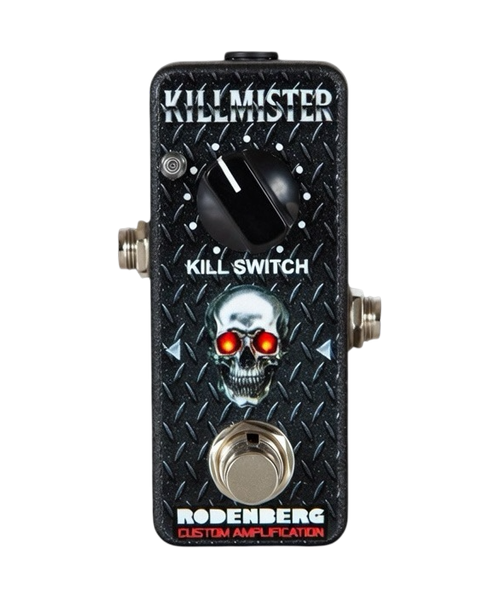


AUTO KILL SWITCH

  • Stepless Auto Kill Switch
  • Manual or automatic operation 
  • Special relay for pure, signal-clean HARD KILL switching
  • The control knob is deliberately stiff, ensuring your setting won’t be accidentally changed on the pedalboard.
  • True Bypass
  • Suitable for all instruments
  • KILLMISTER – The Tone KILLER

    The KILLMISTER is back, more brutal, more flexible, and uncompromisingly designed for live performance. With the new 2025 version, the iconic momentary Kill Switch evolves into a dynamic effect tool featuring a continuously adjustable Auto Kill mode. Whether subtle cuts or aggressive rhythmic patterns: the stepless control lets you dial in the perfect kill speed at any time, no fixed steps, no limits.


FEATURES

  • Manual or Automatic - You Decide
    Position 0:

    The KILLMISTER operates in classic mode, the signal is muted only while the footswitch is pressed. Perfect for precise cuts, rhythmic accents, and live stutter effects in the style of Tom Morello or Buckethead.
  • Turn Up = Engage Auto Kill:
    From the very first turn, the Auto Kill mode is activated. The signal is now muted automatically at regular intervals. The further you turn the control, the faster the pulse rate becomes.
  • Fully Turned Up:
    Kill rate of approx. 100 ms, resulting in a machine-gun-like effect, ideal for glitch-style patterns or aggressive signal interruptions.
  • The control knob is deliberately stiff, ensuring your setting won’t be accidentally changed on the pedalboard.
  • The KILLMISTER 2025 is not a gimmick, it’s an instrument. From subtle rhythmic cuts to brutal stutter effects, everything is under your foot and in your hands.
SOUNDS
KILLMISTER
  • Manual or automatic operation
  • HARD KILL to ground
  • True Bypass
  • The control knob is deliberately stiff, ensuring your setting won’t be accidentally changed on the pedalboard.
  • Suitable for all instruments
SPECS
Power Supply
  • 9-18V DC, 20mA
  • Standard operating voltage: 9 V DC
  • Maximum operating voltage: 18 V DC
  • No battery operation
Dimensions
  • Black powder-coated aluminum enclosure
  • Dimensions: 1.2 x 3.6 x 1.2 (W × D × H)
  • Weight: 0.55 lbs
Made in Germany
  • 3-year warranty
  • Handcrafted in small production runs
Switching Acoustics – 'Click'
  • Switching acoustics:
    Like its predecessor, the KILLMISTER uses a true mechanical special-purpose relay. This relay produces a subtle 'click' sound, which may be audible during slower kill rates or when notes and chords are allowed to ring out.
  • Why this happens:
    The relay physically switches the signal to ground, an extremely fast, effective and deliberately hard switching method. This results in a light, rhythmic clicking sound when opening and closing the signal, comparable to the switching behavior of analog sequencers or vintage drum machines.
  • Live or in the mix? No problem.
    In a band context or with distorted signals, the clicking is virtually inaudible.
    For especially sensitive setups, the KILLMISTER can also be operated in the effects loop (between preamp and power amp), where the switching noise becomes completely imperceptible.
  • A feature many players appreciate:
    The 'click' impulse adds rhythmic articulation, making the pedal feel alive and organic. It reinforces the hard, machine-like character that makes the KILLMISTER truly unique.

VIDEOS

KILLMISTER demo by Fabian Ratsak
KILLMISTER - old version - demo by flowguitarman

FAQ

Power Supply 9V DC - 18V DC
The pedal can be operated with 9–18V DC. Regardless of the supplied voltage, the internal circuitry remains fully stabilized, ensuring that the fundamental tone does not change. The standard operating voltage is 9V DC.
A higher voltage is possible, but not necessary.

Power Supply Notice:
For noise-free operation, we recommend using a stabilized, well-shielded power supply. Some digital power supplies, especially those with insufficient shielding, may cause hum or high-pitched noise.

When using a multi-output power supply, the outputs should be galvanically isolated from each other.

Any noise issues do not originate from the pedal itself, but are usually caused by an unsuitable power supply or an unfavorable device combination. It is possible that a power supply works perfectly with one pedal but produces noise with another.

If noise occurs, we recommend the following test:
Connect the pedal directly to the amplifier, do not connect a guitar, and power the pedal using a separate power supply. When switching the pedal on, only operation or gain-related switching and control noises should be audible, no hum and no high-pitched noise. This test is an effective way to check the pedal independently of the rest of the signal chain.