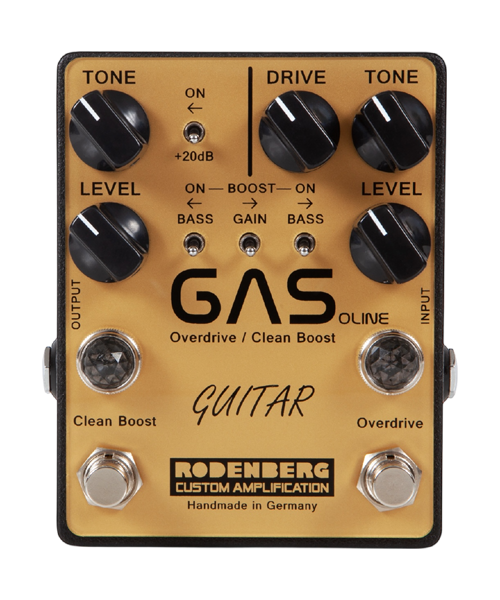
LOW – HIGH GAIN OD / BOOST

  • Authentic, highly responsive overdrive with strong mid presence
  • Works equally well in front of clean, edge-of-breakup and driven amps
  • LOW / HIGH GAIN Overdrive selectable via preset switch
  • Tight low-end push without muddiness
  • Two clearly separate sounds in one pedal: LOW/HIGH GAIN Overdrive and Clean Boost in one pedal.
  • GAS (OD/CB)    GAS = GASOLINE

    The GAS (OD/CB) combines classic overdrive character with a powerful Clean Boost that already moves in the direction of an exciter. It was developed for guitarists who don’t want to change their fundamental tone, but refine it, adding pressure, clarity and control.


FEATURES

  • The GAS (OD/CB) delivers an authentic, highly assertive overdrive with fast response and exactly the right amount of character for blues and rock. In front of a clean amplifier, it produces an open, dynamic drive sound with plenty of expression and transparency. When used with an edge-of-breakup or fully driven amp, it works as a precise tone shaper, tightening, focusing and pushing the existing sound forward without ever becoming muddy.
  • Using the GAIN preset switch, the overdrive can be flexibly set from LOW GAIN to HIGH GAIN. Throughout the entire range, the tight low-end push adds punch and authority while preserving clarity and definition. This results in two clearly distinct sounds in one pedal: from a transparent blues drive to a powerful, controlled rock overdrive with strong projection and focus.
  • The pedal features a specially developed mechanical True Bypass switching system with optimized noise suppression, delivering nearly pop-free switching, ideal for professional stage use.
  • Handcrafted in Germany, the GAS (OD/CB) delivers maximum dynamics, tonal accuracy, and flexibility for musicians who demand uncompromising performance.

CLEAN / DRIVE

In front of a clean amp

In front of a clean-set amp, the GAS (OD/CB) produces an open, dynamic blues-rock overdrive. The core tone stays clear and defined, while the pedal adds character, punch and authority. Engaging the Clean Boost doesn’t just raise the volume for solo boosts, it opens up the amp, adding presence and energy, already leaning toward an exciter-like response.

In front of a driven or distorted amp

With an already breaking-up or distorted amp, the GAS (OD/CB) becomes a precise Drive and Boost partner. The overdrive tightens and focuses the existing distortion without smearing it, adding definition and punch.

Activating the Boost pushes the tube amp further into saturation, increasing sustain, harmonics and presence, ideal for lead work and powerful rhythm sounds.

SOUNDS
LOW - HIGH GAIN Overdrive
  • Jewel LED Blue
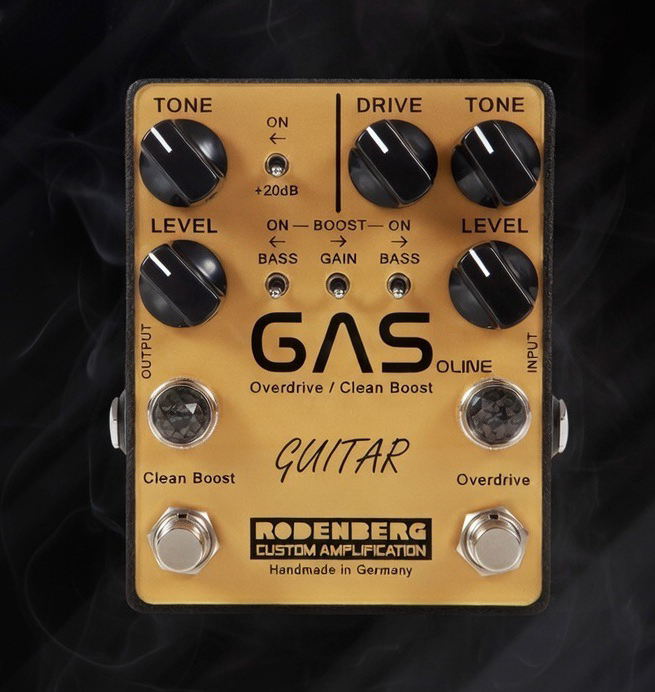
  • LOW - HIGH GAIN Overdrive (Preset toggle switch)
  • BASS Boost (Preset Toggle switch)
  • Controls: Level, Tone, Drive
BOOST
  • Jewel LED Green
  • BASS Boost (Preset Toggle switch)
  • +20 dB Level Boost (Preset Toggle switch)
  • Controls: Level, Tone
SPECS
Silent True Bypass
  • Mechanical True Bypass footswitch
  • Newly developed switching concept
  • Almost no switching noise, no audible pops
Power Supply
  • 9-18V DC, 50 - 80mA
  • Standard operating voltage: 9 V DC
  • Maximum operating voltage: 18 V DC
  • No battery operation
Dimensions
  • Black powder-coated aluminum enclosure
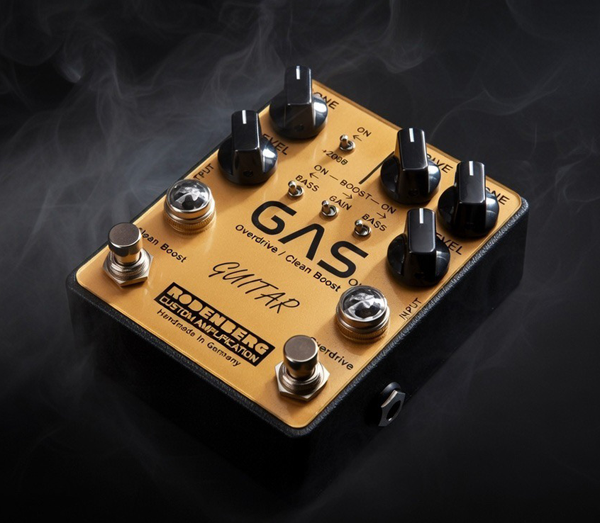
  • Dimensions: 3,7 x 4.7 x 1.3 (W × D × H)
  • Weight: 0.99 lbs
Made in Germany
  • 3-year warranty
  • Handcrafted in small production runs

VIDEOS

GAS demo by Fabian Ratsak

FAQ

Power Supply 9V DC - 18V DC
The pedal can be operated with 9–18V DC. Regardless of the supplied voltage, the internal circuitry remains fully stabilized, ensuring that the fundamental tone does not change. The standard operating voltage is 9V DC.
A higher voltage is possible, but not necessary.

Power Supply Notice:
For noise-free operation, we recommend using a stabilized, well-shielded power supply. Some digital power supplies, especially those with insufficient shielding, may cause hum or high-pitched noise.

When using a multi-output power supply, the outputs should be galvanically isolated from each other.

Any noise issues do not originate from the pedal itself, but are usually caused by an unsuitable power supply or an unfavorable device combination. It is possible that a power supply works perfectly with one pedal but produces noise with another.

If noise occurs, we recommend the following test:
Connect the pedal directly to the amplifier, do not connect a guitar, and power the pedal using a separate power supply. When switching the pedal on, only operation or gain-related switching and control noises should be audible, no hum and no high-pitched noise. This test is an effective way to check the pedal independently of the rest of the signal chain.